
Guide - Colmi R02
How reliable is Colmi R02 ring data, really
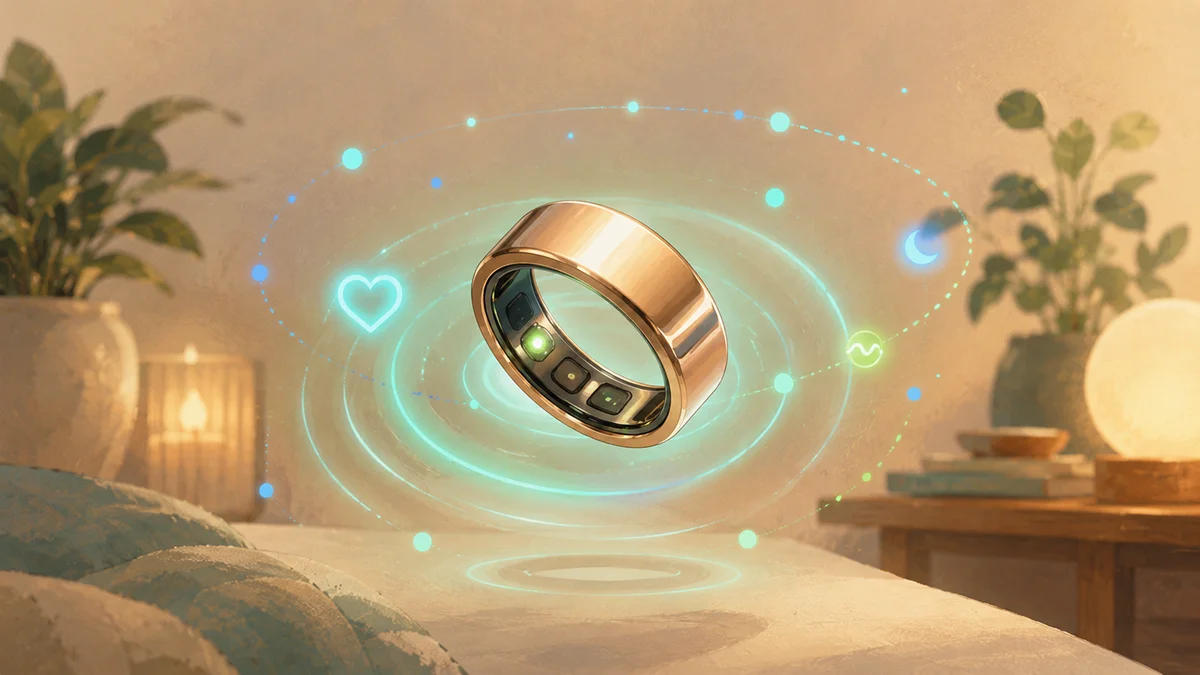
The right question is not whether the Colmi R02 is as precise as a medical instrument (it is not, and it does not need to be), but whether its data is consistent enough to be useful. It is, if you read it as trends. Here is what the ring measures, how to interpret each metric, and how FitMesh reads it over Bluetooth and shows it in the web panel alongside your smartwatch.
요약
- "Reliable" for a consumer ring does not mean as precise as a clinical instrument: it means consistent day after day, so the trends make sense.
- The Colmi R02 measures steps, heart rate, SpO2, sleep with stages, stress and battery as wellness metrics, not diagnostic readings.
- The value is in comparing yourself with yourself over time: the direction of the trend matters more than one night's single number.
- Wear it the same way every time and read it in weeks, not minutes: that is how the data becomes useful.
- FitMesh reads the ring over Bluetooth and shows everything in the web panel alongside your smartwatch, with no double counting.
You bought a Colmi R02, or you are about to, and the question is always the same: can you trust the data? It is the right question, but it is almost always asked the wrong way. "Reliable", for a ring that costs a few tens of euros, does not mean as precise as a clinical instrument, and it does not need to. It means something else, something far more useful day to day: the numbers are consistent enough, night after night, to show you a direction. This guide covers what the Colmi R02 actually measures, how to read each metric without fooling yourself, and how FitMesh reads the ring over Bluetooth to show everything in the web panel alongside your smartwatch.
"Reliable" for a consumer ring: what it actually means
An instrument is reliable when, under the same conditions, it repeats the same reading. That is not the same as "correct to the decimal". A consumer ring can read your resting heart rate a few points above or below the true value and still be genuinely useful, because what matters is that it errs consistently in the same direction: if tonight it reads a few points higher than your average over the past two weeks, that comparison is informative even if the absolute number is not textbook. The Colmi R02 works well exactly on this ground. Its strength is not the single reading, it is the series: dozens of aligned readings that draw a baseline that is yours, personal, and against which you compare each day.
What the Colmi R02 measures (and how to read each metric)
| Metric | What it shows | How to read it well |
|---|---|---|
| Steps and distance | Daily movement | Look at the weekly average, not a single day |
| Heart rate | Beat through the day | Follow the pattern at rest and under effort over time |
| Resting HR | Beat when still, typically at night | Treat it as your baseline: note shifts from your own average |
| Overnight SpO2 | Estimated saturation during sleep | Read it as a trend across nights, never as a spot reading |
| Sleep with stages | Light, deep, REM, awake | Use duration and regularity, not one night's exact percentage |
| Stress | 0-100 index from heart rate variability | Follow the daily curve and the peaks that recur |
| Battery | Ring's remaining charge | Practical indicator for when to recharge |
Four rules for reading the data without fooling yourself
- Read trends, not single numbers. One bad night says nothing; seven nights trending down say something. The direction matters more than any single reading.
- Compare yourself with yourself. Your personal baseline is the only sensible yardstick: generic "average" reference values mean little when the ring is on someone else's finger.
- Wear it consistently. Same finger, stable position, snug but not tight: the consistency of contact between sensor and skin is what makes two readings comparable.
- Give the baseline time. It takes one or two weeks of continuous wear, nights included, before trends start to mean anything. The first days are noise, not signal.
Where the data is more consistent, where caution helps
A
Where the ring is more consistent
- •Resting HR at night: the hand is still and contact is stable, the reading is among the steadiest
- •Sleep regularity: bedtime and wake time, total duration
- •Step trend read over the week
- •Stress pattern across a typical day
B
Where to read with more caution
- •SpO2 as a single night's absolute value: look at it as a multi-night trend
- •Step counts during manual work or driving: hand motion confuses the sensor
- •Sleep stages taken as one single night's exact percentage
- •Heart rate during very intense effort with the hand moving
FitMesh: the tool that actually reads the ring
The Colmi R02's limit is not its sensors, it is where the data ends up. Out of the box it stays locked in the manufacturer's app, cut off from everything else. FitMesh Sync fixes that: it connects to the ring over direct Bluetooth, pulls steps, heart rate, SpO2, sleep with stages, stress and battery level, and shows them in the web panel next to your smartwatch data. One place to watch the trends, reachable from any browser with the same account. On Android the app is already on the Play Store: it reads the phone's health platform and, on top of that, reads the Colmi ring directly over Bluetooth. The iOS version is on the way. Your data stays on your account, on servers in Europe, not on the ring maker's servers. For the full overview see the complete Colmi ring guide; for sleep, how to track sleep with the ring; and to make sense of the stress index, what HRV means and its values.
Ring by night, smartwatch by day: no double counting
Many people use the Colmi R02 for the night, where it is comfortable, and a smartwatch by day, where it has GPS and a screen. The obvious risk is counting the same step or the same hour of sleep twice when you wear both. FitMesh merges the two sources and deduplicates: the same step does not get counted twice, and when two devices cover the same time window the app keeps the reading best suited to that moment. The result is a single, coherent day instead of two overlapping timelines. If you use several devices together, how to combine them without double data explains the logic in detail. This is where the ring shines: as the overnight specialist inside a picture that also covers the rest of the day.
자주 묻는 질문
What exactly does the Colmi R02 measure?+
Steps and distance, heart rate through the day, resting heart rate, overnight SpO2, sleep with stages (light, deep, REM, awake), a stress index from 0 to 100 and the ring's battery level. These are all consumer wellness metrics, meant to follow your trends, not to make a diagnosis.
Is the Colmi R02 data reliable?+
It is reliable in the sense that actually matters: it is consistent over time. Do not expect the precision of a clinical instrument, but if you wear the ring consistently the repeated readings draw legible trends (resting heart rate, sleep regularity, stress pattern) that tell you whether you are heading one way or another. A single reading at a single moment is worth little; the series of many readings is worth a lot.
How do you read the trends without getting it wrong?+
Compare yourself with yourself and think in weeks, not minutes. Take your average over the past two weeks as a baseline and watch which way it moves: a single off-the-chart night is noise, a shift that repeats over days is a signal. Avoid weighting a single night's absolute value, especially for SpO2 and sleep stages, which should be read across several nights.
Can the Colmi R02 replace a doctor or a diagnosis?+
No, and it is not designed to. It is a consumer wellness device, not a medical device: its data is informational and meant to help you notice your own changes, not to diagnose or rule anything out. If a trend worries you or you have a symptom, your doctor is the reference. FitMesh shows this data as personal information, never as clinical reports.
How do I connect the Colmi R02 to FitMesh?+
You install FitMesh Sync on Android from the Play Store, create your account and add the ring: the app finds it over Bluetooth and pulls the data directly, with no need for the manufacturer's app. From then on you see steps, sleep, heart rate, SpO2 and stress in the web panel, reachable from any browser with the same account. The iOS version is on the way. For step-by-step setup see the [Colmi R02 setup guide](/en/blog/colmi-r02-setup).
면책 조항
FitMesh Sync는 독립 제품입니다. Colmi은(는) 각 소유자의 상표입니다. 이 기사는 어떠한 제휴나 후원도 암시하지 않습니다.
의료 면책 조항
이 기사의 정보는 정보 제공 목적으로만 제공되며 의사, 약사 또는 기타 의료 전문가의 조언을 대체하지 않습니다. FitMesh Sync는 피트니스/웰니스 앱이며 의료 기기가 아니며 어떠한 질환도 진단하거나 치료하지 않습니다. 증상, 임상 질문 또는 치료 결정에 대해서는 항상 주치의와 상담하세요.
Written by
Matteo Pizzi
Founder & Solo Dev, FitMesh Sync · Fosforonero
Italian software developer. I built FitMesh Sync to fill the gap between my smartwatch and a real personal dashboard. Privacy-first, indie, EU servers.
More about the project계속 읽기
가이드
Colmi R02: 25유로짜리 스마트 링으로 모든 건강 데이터를 드디어 동기화하는 방법
Colmi R02는 걸음 수, 심박수, SpO2, HRV, 스트레스, 배터리를 측정합니다. 문제는 데이터가 제조사 컴패니언 앱에 갇혀 있다는 것. FitMesh Sync는 블루투스로 직접 연결해 컴패니언 앱 없이 모든 데이터를 대시보드에 통합합니다.
가이드
Colmi R02 설정 가이드: 사용 방법과 데이터 읽는 법
Colmi R02를 막 받았고 어떻게 작동하는지, 올바르게 착용하는 방법, 스마트워치와 함께 FitMesh에 데이터를 가져오는 방법을 알고 싶으신가요? 이 가이드는 박스를 여는 것부터 첫 번째 통합 대시보드까지 모든 것을 다룹니다.
가이드
스마트 링으로 수면을 추적하는 방법
스마트 링과 수면 추적: 착용감, 배터리 수명, 야간 수면 단계. Colmi R02가 측정하는 것, 데이터를 해석하는 방법, 그리고 FitMesh가 야간 링 데이터를 낮 시간 워치 데이터와 연결하는 방법.